By the Editorial Desk Original reporting and community analysis derived from Electrek
Main Facts
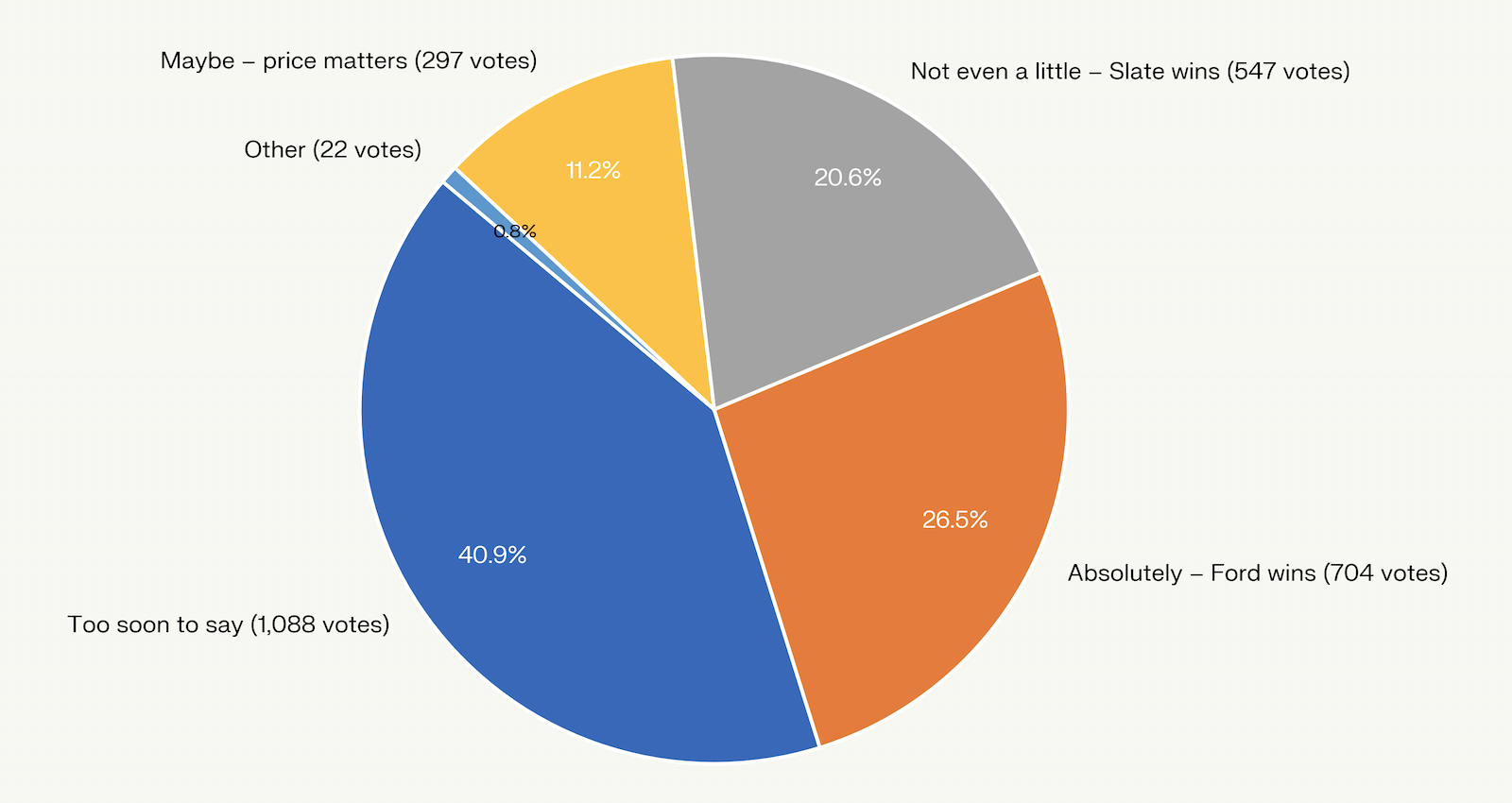
The modern electric vehicle (EV) market is entering a pragmatic, cost-conscious era. For weeks, Electrek hosted a high-engagement sidebar survey addressing a critical question facing the automotive landscape: Did the announcement of Ford’s upcoming all-electric, $30,000 Fathom pickup truck effectively neutralize the pre-launch momentum of the Jeff Bezos-backed startup Slate Auto?
With a price tag sitting just a few thousand dollars above the ultra-minimalist Slate, the Ford Fathom poses an existential threat to the newcomer. Nearly 2,700 readers weighed in, providing a quantitative breakdown and qualitative insights into the clash between legacy manufacturing power and nimble startup ambition.
While the majority of respondents adopted a cautious "wait and see" approach, the vocal minority offered sharp, deeply informed perspectives. The debate centers on several core pillars:
Pricing Parity: The Fathom’s target entry price narrows the financial gap that startups rely on for initial disruption.
The Legacy Burden: The debate over whether Ford’s extensive dealer network is a superpower or a toxic liability plagued by markups.
The "Model T" Philosophy: Whether Slate’s back-to-basics ethos is a genuine modern revival of Henry Ford’s original vision or an outdated concept.
The Chilling Effect: The psychological impact that a major automaker’s future promise has on consumer purchasing intent today.
Chronology of Events
To understand the friction between the Ford Fathom and Slate Auto, it is necessary to examine the timeline of events leading up to this market face-off:
The Rise of Back-to-Basics EVs: As high-end, luxury electric trucks with six-figure price tags saturated the early EV market, a glaring void emerged for affordable, utilitarian, and easily repairable work vehicles. Slate Auto stepped into this space with backing from high-profile investors like Jeff Bezos, promising a modular, stripped-down, highly customizable utility vehicle.
Ford Announces the Fathom: Shaking up the affordable EV segment, Ford revealed plans for the Fathom—an all-electric pickup priced aggressively around $30,000. By coming in just a few thousand dollars higher than Slate’s bare-bones offering, Ford instantly entered the same consumer consideration set.
The Electrek Survey Launch: To gauge consumer sentiment, Electrek launched a multi-week sidebar survey asking readers if Ford’s maneuver had effectively killed Slate Auto before its vehicles even reached consumers.
The Tally and Community Discourse: Accumulating nearly 2,700 responses, the survey exposed deep ideological divides among EV enthusiasts regarding traditional dealerships, direct-to-consumer models, and corporate staying power.
Supporting Data
The survey results revealed a clear split between fence-sitters and passionate automotive analysts:
The Pragmatic Majority: The largest blocks of respondents chose non-committal options, such as "Maybe — but every penny counts for some buyers, and a few thousand dollars is a LOT of pennies!" and "Too soon to say — neither truck is even out yet!"
The Vocal Minority: Though outnumbered by the cautious crowd, opinionated commenters provided the core substance of the debate, highlighting structural advantages and disadvantages for both brands.
The quantitative results reflect a consumer base that recognizes the appeal of ultra-low-cost electric trucks but remains deeply skeptical of how legacy automakers and startups will execute their go-to-market strategies.
Official Responses and Community Insights
While corporate PR departments continue to frame their respective products as revolutionary, the most illuminating perspectives came directly from the automotive community.
The Dealer Dilemma: Asset or Anchor?
One of the most fierce debates centered around Ford’s legacy infrastructure—specifically, its nationwide network of franchised dealerships.
Commenter NickD argued that Ford’s presumed advantage could easily become its undoing:
"Ford’s dealer network will be all too happy to sabotage the Fathom through ridiculous markups and terrible sales experience. Slate has an opening to exploit for that reason alone."
This sentiment was echoed by Scott Z, who has actively avoided traditional dealerships for two decades:
"Ford has a large anchor around its neck. It is called Dealerships. They suck and almost everyone agrees. Paying a middleman for nothing is not fun for most… That is why for the last 20 years when I wanted a vehicle I went to companies like Carmax or to Tesla and Rivian."
Modernizing the Model T and the Falcon
Other commentators looked back through automotive history to contextualize the battle. Regular commenter Mrvc drew a spiritual parallel between Slate Auto and Henry Ford’s original revolutionary vehicle:
"The thing that keeps coming to my mind is Ford claiming they want to have a model t moment. Yet slate basically built a modern model t. One color, very user customizable to meet their or their business needs. Local service that isn’t franchised with high end-user repairability."
Mrvc further noted that Slate’s business model is structured to lower prices as production costs decrease—a trajectory they believe legacy giants like Ford, who frequently raise annual model-year prices, struggle to match.
Building on that historical theme, Mark Horning invoked another classic Ford nameplate:
"I’ve said it before, but this is Ford’s ‘Falcon’ moment. Ford built Falcons in 2-door, 4-door, wagon, ranchero configurations. And they sold over a million in the first 2 years."
Implications
What does this dynamic mean for the future of affordable electric transportation? According to user Taycan, the immediate danger to Slate Auto may not be the physical performance of the Fathom, but the psychological impact of its announcement:
"The first problem for Slate isn’t how good the Fathom is if it ever arrives, it’s the chilling effect that the idea that there is a Fathom coming has on Slate orders."
The "Waiting Game" Phenomenon
When a household name like Ford announces an affordable, highly anticipated product, it immediately alters consumer behavior. Prospective buyers who might otherwise have placed a deposit on a Slate vehicle are suddenly inclined to pause, adopt a wait-and-see attitude, and evaluate what the Blue Oval has to offer.
This phenomenon is not unfamiliar to Ford. Under CEO Jim Farley, the company previously experienced the fallout of the "waiting game" when consumer anticipation for North American Charging Standard (NACS) integrations and next-generation EV platforms temporarily stalled existing sales and required billions in redirected R&D adjustments.
Conclusion: Can Slate Survive the Shadow of Giants?
Slate Auto occupies a unique, highly focused niche. If it can deliver a modular, highly repairable, direct-to-consumer vehicle without the friction of dealer markups, it may carve out a loyal base of commercial and utilitarian buyers.
However, the Fathom proves that the golden age of cheap EVs is no longer an open playground for startups. Even if the Fathom never fully realizes its initial promises or encounters production delays, its mere existence casts a long shadow over the balance sheets and order books of every competitor trying to break into the sub-$35,000 electric vehicle market.