

Main Facts: The Ascent of Silicone and the Equipment Dilemma
The commercial roofing industry is undergoing a significant technological shift, driven by the rapid adoption of silicone liquid-applied membranes. Recognized as one of the fastest-growing sectors in roof restoration, silicone coatings offer seamless, moisture-cured barriers that excel in ponding water resistance, UV stability, and thermal efficiency. However, this high-performance chemistry introduces unprecedented operational complexity for commercial contractors.
To successfully enter or scale within this lucrative market, roofing companies must navigate a stark equipment landscape. The capital expenditure required to deploy a silicone application crew ranges from as little as $1,000 for basic mechanical rolling setups to upwards of $30,000 for advanced, high-pressure hydraulic spray systems. This vast pricing disparity is dictated by the viscosity of silicone materials, hose lengths, pump engineering, and job site parameters.
Beyond the financial investment, the technical nature of silicone demands highly trained personnel. Because silicone is a moisture-cure polymer, improper handling can lead to catastrophic equipment failures, while high operating pressures introduce severe safety hazards. Consequently, contractors must carefully balance capital allocation, project scale, and crew capabilities when choosing their application methods.
Chronology: From Tar to Polymers—The Evolution of Liquid-Applied Roofing
The rise of silicone coatings represents the latest chapter in a decades-long evolution of commercial roofing restoration and maintenance.
[1970s–1980s] ------------------> [1990s] ----------------------> [2000s–Present]
Asphalt & Coal Tar               Acrylics & Polyurethanes         Silicone & High-Solids
• High labor, high emissions     • Water-based, user-friendly     • Premium ponding water resistance
• Prone to thermal cracking • Degraded by standing water • High material viscosity, technical application- The Traditional Era (Mid-to-Late 20th Century): For decades, commercial flat roofing relied heavily on built-up roofing (BUR) systems utilizing hot asphalt or coal tar pitch. While durable, these systems required immense labor, posed severe burn and fume hazards, and offered poor reflectivity.
- The Elastomeric Shift (1980s–1990s): The introduction of acrylic and polyurethane liquid coatings provided a lighter, cold-applied alternative. Acrylics became popular for their reflectivity and ease of cleanup, but they suffered from a critical vulnerability: they are water-based and degrade rapidly under ponding water.
- The Silicone Revolution (2000s–Present): To solve the ponding water issue, manufacturers developed silicone coatings. Unlike acrylics, silicone is inorganic and highly hydrophobic, allowing it to withstand permanent standing water without softening or delaminating.
- The Equipment Evolution: Early silicone formulations required heavy solvents for application. However, environmental regulations and the push for higher performance led to the development of "high-solids" silicones (often 90% to 95% solids by volume). These modern formulations are environmentally friendly and can be applied in a single thick pass, but their high density and viscosity have forced equipment manufacturers to engineer specialized, heavy-duty delivery systems.
Supporting Data: A Technical and Financial Breakdown of Application Methods
Contractors evaluating silicone application must choose between two primary methodologies: roll-applied systems and spray-applied systems. Each option presents distinct technical specifications, financial profiles, and operational limitations.
+-----------------------------------------------------------------------------------------+
|                               SILICONE APPLICATION SYSTEMS                              |
+-----------------------------------------------------------------------------------------+
|                                           |                                             |
|           ROLL-APPLIED SYSTEMS            |            SPRAY-APPLIED SYSTEMS            |
|            ($1,000 - $3,000)              |             ($15,000 - $30,000+)            |
|                                           |                                             |
|  [Vat / Flow-Control]                     |  [Hydraulic Pump / Engine]                  |
|          │                                |              │                              |
|          ▼                                |              ▼                              |
|  [Gravity-Fed Frame]                      |  [High-Pressure Hose (250ft+)]              |
|          │                                |              │                              |
|          ▼                                |              ▼                              |
|  [6" Dia. Roller (14"-40" Width)]         |  [Heavy-Duty Spray Gun (0.029"-0.043" Tip)] |
|                                           |                                             |
|  • Best for: Small/mid jobs, high wind    |  • Best for: Large open decks, high volume  |
|  • Speed: Moderate (Manual labor heavy)   |  • Speed: High (Up to 15,000 sq ft/day)     |
|                                           |                                             |
+-----------------------------------------------------------------------------------------+
The Roll-Applied Method: Accessibility and Wind Resilience
For contractors entering the silicone market or managing smaller footprints, the roll-applied method represents the lowest barrier to entry. Rather than using standard residential paint rollers, commercial crews utilize specialized mechanical rolling systems.
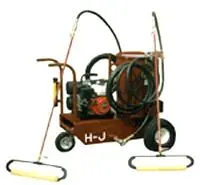
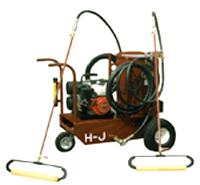
- Equipment Specifications: Commercial-grade silicone rollers typically feature a large 6-inch diameter and range in width from 14 to 40 inches. These heavy-duty rollers are mounted on a wheeled metal frame integrated with a material vat. The vat features calibrated flow-control holes that gravity-feed or pressure-feed the viscous silicone directly in front of the roller sleeve.
- Cost Analysis: Setting up a crew with commercial rolling frames, vats, and replacement sleeves costs between $1,000 and $3,000.
- Operational Advantages:
- Wind Mitigation: One of the greatest liabilities in spray application is "overspray"—the drift of atomized silicone droplets onto adjacent buildings, structures, and vehicles. Wind speeds as low as 10 mph can halt spraying operations. Rolling eliminates this risk entirely, allowing crews to work in breezy conditions.
- Low Maintenance: Unlike sprayers, rolling equipment does not feature complex internal valves, seals, or engines, drastically reducing downtime and cleanup labor.
- Operational Disadvantages: Rolling is labor-intensive and significantly slower than spraying, making it economically unviable for massive, open-acreage roofs.
The Spray-Applied Method: High-Output, High-Capital Engineering
For large-scale commercial contractors, spray application is the industry standard for maximizing production rates. However, the high viscosity of high-solids silicone requires specialized, industrial-grade airless sprayers.
- Equipment Specifications: Standard airless sprayers designed for latex paint will fail under the load of heavy silicone. Professional silicone sprayers must generate operating pressures between 4,000 and 7,000 PSI and support delivery rates of at least 3 to 5 gallons per minute (GPM).
- Cost Analysis: These high-performance units range from $15,000 to $30,000. The price variance is driven by:
- Hose Length: Silicone’s flow resistance requires high-pressure, moisture-impermeable hoses. Extending hose runs from 150 feet to over 250 feet requires larger engines and heavier fluid sections to maintain pressure at the gun.
- Hydraulic Auxiliaries: Premium rigs include hydraulic lifts to raise and lower the heavy fluid section directly out of 55-gallon drums, as well as integrated hydraulic mixers to keep the silicone homogeneous.
- Instrumentation: Advanced units feature electronic pressure monitoring and diagnostic systems to prevent pump burnouts.
- Operational Advantages: A trained spray crew can apply silicone to 10,000 to 15,000 square feet of roof per day, drastically reducing labor costs and shortening project timelines.
- Operational Disadvantages: High capital cost, extreme vulnerability to wind drift, and intensive daily maintenance to prevent the silicone from curing inside the pump.
Official Responses and Expert Perspectives: Operational Safety and Customization
Industry veterans emphasize that purchasing the equipment is only the first step; understanding the operational nuances and safety hazards is what dictates profitability.
Pat Amicucci, an industry specialist representing Roofmaster®—a leading roofing equipment manufacturer with 70 years of market experience—highlights the complexity of custom-fitting contractors with the correct machinery. Amicucci notes that because the transition to silicone is not a "black and white" decision, contractors must assess their target project sizes, labor availability, and geographic wind patterns before investing.
"Silicone has become one of the fastest growing roof coating applications today and one of the more technical," Amicucci explains. "Crews need to be familiar with the operations and dangers associated with the equipment."
The Danger of High-Pressure Injection Injuries
Safety directors across the roofing sector warn that the high pressures generated by $30,000 hydraulic sprayers introduce severe health risks. At pressures exceeding 4,000 PSI, a leak in a hose or a negligent finger near the spray tip can cause a fluid injection injury. This occurs when the high-viscosity silicone pierces human skin, injecting toxic polymer deep into muscle tissue. Such injuries are medical emergencies that require immediate surgical intervention to prevent amputation or systemic poisoning.
The Maintenance Nightmare of Moisture-Cure Chemistry
Technical representatives from major silicone manufacturers emphasize that because silicone cures by reacting with moisture in the air, any humidity introduced into the spray system will cause the material to solidify inside the hoses and pump. If a crew fails to perform a thorough solvent flush (using mineral spirits or virgin naphtha) at the end of a shift, a $20,000 sprayer can be permanently ruined overnight.
Implications: Labor, Sustainability, and the Future of the Roofing Market
The choices commercial contractors make regarding their silicone application equipment have far-reaching implications for the broader construction industry, labor markets, and environmental sustainability.
+----------------------------------------------------------------------------------------+
|                               ECONOMIC & MARKET IMPLICATIONS                           |
+----------------------------------------------------------------------------------------+
|                                                                                        |
|   [Climate & Sustainability] ────► High-solids silicone increases solar reflectance,    |
|                                    reducing building cooling costs by up to 35%.       |
|                                                                                        |
|   [Labor Dynamics]           ────► Sprayers offset severe commercial labor shortages    |
|                                    by maximizing daily square-footage output.          |
|                                                                                        |
|   [Capital Allocation]       ────► Section 179 tax deductions allow contractors to      |
|                                    write off 100% of $30k sprayer investments.         |
|                                                                                        |
+----------------------------------------------------------------------------------------+
Climate Change and the "Cool Roof" Mandate
As municipal building codes and international standards increasingly mandate "cool roofs" to combat the urban heat island effect, the demand for highly reflective white silicone coatings is projected to surge. High-solids silicone coatings can reflect up to 85% of solar radiation, reducing building cooling costs by as much as 35%. Contractors equipped with the right machinery—whether high-volume sprayers for flat industrial complexes or versatile rolling vats for tight urban spaces—will capture the lion’s share of this green energy transition.
Labor Shortages Driving Automation and Efficiency
The commercial construction sector continues to struggle with a chronic shortage of skilled labor. In this environment, spray-applied silicone systems act as a force multiplier. By investing $30,000 in a high-output hydraulic spray rig, a contractor can achieve the same daily square-footage output with a three-man crew that would historically require an eight-man crew using traditional roll or mop methods.
Financial and Tax Incentives
To offset the high capital cost of premium spray rigs, contractors are increasingly leveraging tax incentives. In the United States, for example, Section 179 of the IRS tax code allows businesses to deduct the full purchase price of qualifying equipment—such as commercial sprayers and heavy-duty rolling frames—in the year it is purchased, rather than depreciating the asset over several years. This financial mechanism lowers the barrier to entry for mid-sized contractors looking to transition from rolling to high-speed spraying.
Conclusion: A Strategic Choice
Ultimately, the silicone roof coating market offers immense growth potential, but success hinges on matching equipment to operational realities. While the speed of a $30,000 hydraulic sprayer is highly attractive, the zero-overspray reliability of a $1,000 mechanical roller remains a vital tool in any commercial contractor’s arsenal. Partnering with experienced industry suppliers like Roofmaster ensures that contractors do not over-leverage themselves on unnecessary technology, but rather deploy custom-fit equipment packages designed for safety, efficiency, and maximum return on investment.
