

By John Davis
Senior Industry Analyst & Technical Contributor
Main Facts: The Critical Link Between Power Generation and Single-Ply Success
Despite persistent global supply chain disruptions and material allocation bottlenecks that have tested the commercial construction sector over the past few years, single-ply membrane roofing remains the undisputed titan of the commercial roofing industry. Thermoplastic polyolefin (TPO), polyvinyl chloride (PVC), and ethylene propylene diene monomer (EPDM) systems continue to capture the lion’s share of low-slope commercial specifications due to their durability, energy efficiency, and relatively rapid installation times.
However, the modern single-ply assembly is not merely a material system; it is a highly engineered, technology-dependent installation process. Unlike the labor-intensive asphalt kettles and torch-applied systems of the past, contemporary thermoplastic installations rely almost entirely on hot-air welding technology. Precision tools, such as the industry-standard Leister automatic and manual hot-air welders, require a continuous, highly stable source of electrical power to fuse membrane seams together at temperatures often exceeding 1,000°F (538°C).
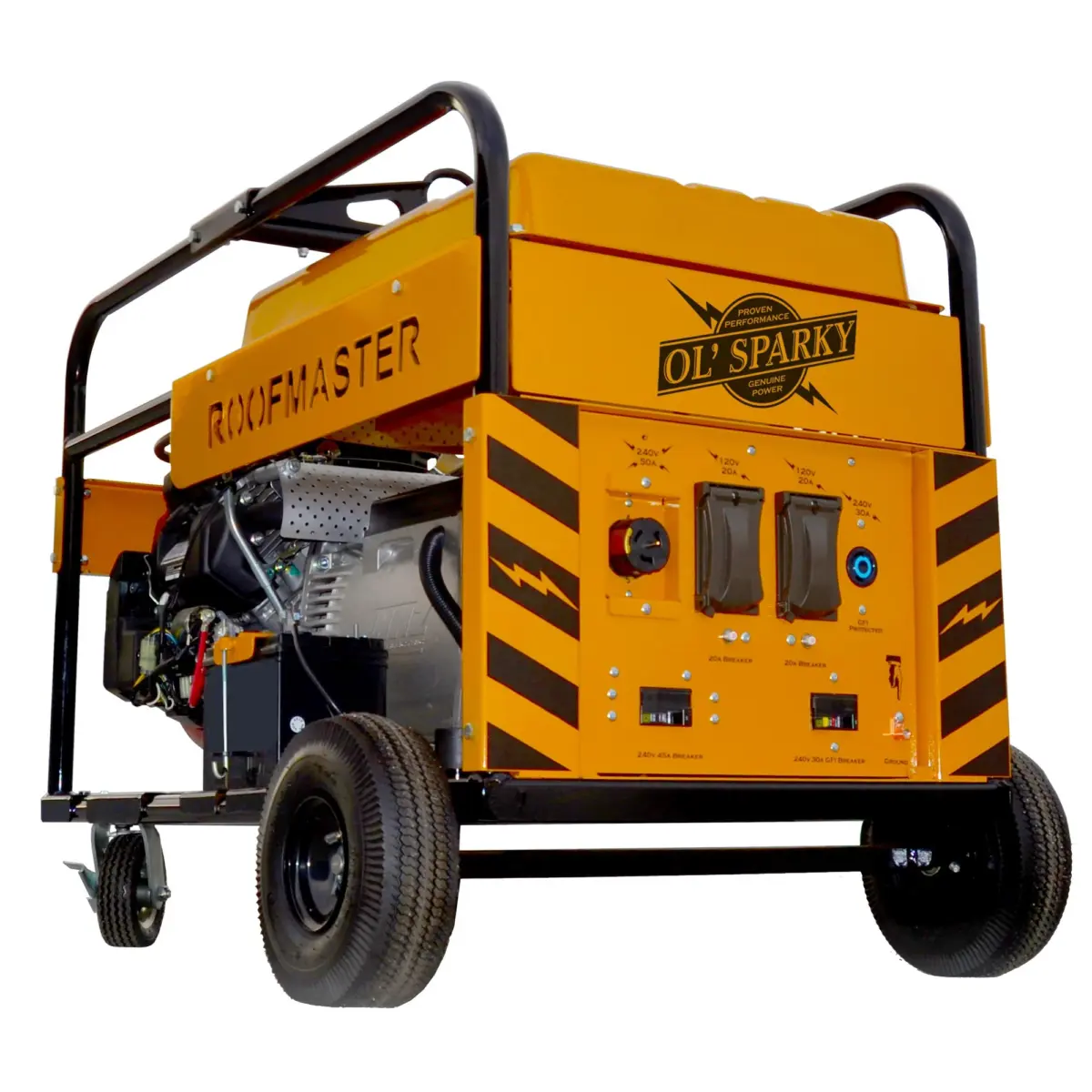
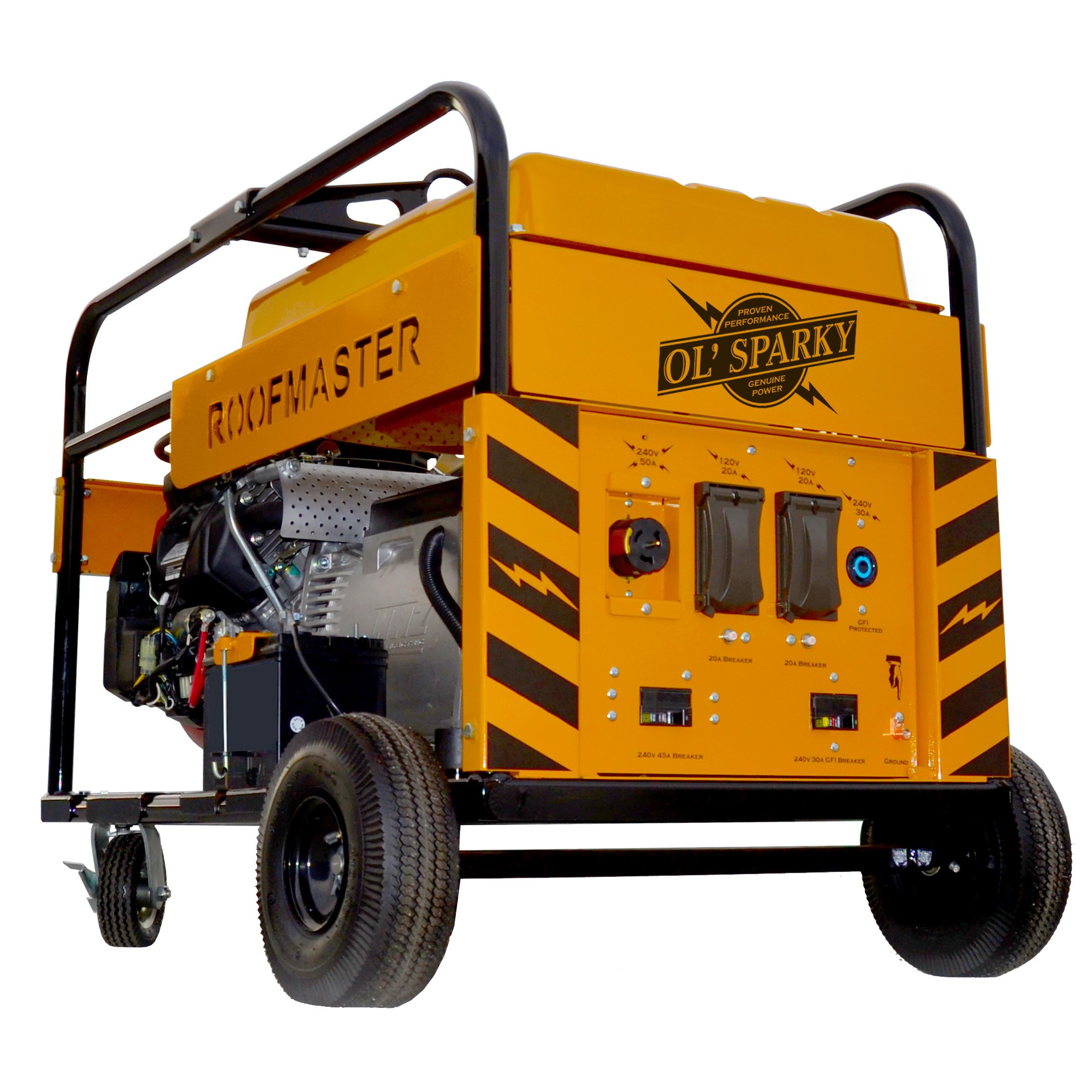
On the vast majority of commercial job sites, utility power is either unavailable, inaccessible, or too unstable to power these sensitive digital tools. Consequently, the portable generator—frequently nicknamed "Ol’ Sparky" or similar monikers by crews on the roof—becomes the single point of success or failure for the entire roofing project.
According to technical service bulletins from Roofmaster® Products Company, a premier supplier and service provider for commercial roofing equipment, generator maintenance is the most frequently overlooked variable in single-ply installation quality. When a generator suffers from voltage fluctuations, dirty fuel, or mechanical wear, the downstream consequences are immediate: ruined control boards on expensive automatic welders, weak or cold welds that fail inspection, and catastrophic project delays.
To address these vulnerabilities, Roofmaster® has expanded its network of dedicated service centers staffed by certified mechanics across key metropolitan logistics hubs, including Los Angeles, California, and the Dallas-Fort Worth metroplex in Texas. These centers specialize in restoring and maintaining both the hot-air welding units and the heavy-duty generators that power them, ensuring contractors can maintain peak operational uptime.
Chronology: The Evolution of Single-Ply Roofing and Field Power Dependencies
[1970s–1980s]
Introduction of early single-ply membranes (EPDM, PVC).
Power demands are low; reliance on hand-welding and chemical adhesives.

[1990s–2000s]
TPO enters the market and rapidly gains market share.
Introduction of digital, high-speed automatic hot-air welders (e.g., Leister Varimat).
Dependence on stable field electricity increases dramatically.

[2020–2022]
Global supply chain crises cause severe shortages in resins, fasteners, and adhesives.
Contractors face tight margins and zero tolerance for equipment downtime.

[2023–Present]
Technological integration of microprocessors in welding equipment.
Generator maintenance shifts from a basic mechanical chore to a high-precision operational necessity.
The rise of single-ply roofing to its current market dominance is a story of chemical engineering and labor optimization. In the late 20th century, the commercial roofing market was dominated by built-up roofing (BUR) and modified bitumen systems. These systems relied on fossil-fuel-heated asphalt or open-flame torches to create a waterproof barrier.
As environmental regulations tightened, insurance premiums for open-flame applications soared, and labor shortages began to pinch the industry, single-ply membranes emerged as a cleaner, safer, and faster alternative.
By the early 2000s, TPO had established itself as the fastest-growing segment in commercial roofing. This transition shifted the primary energy source on commercial roofs from propane and asphalt kettles to electricity. Early hot-air welders were simple, analog heating elements with basic electric motors. They were relatively forgiving of the erratic, "dirty" power produced by cheap, unregulated job-site generators.
However, as membrane chemistry evolved to allow for faster installation speeds, welding equipment underwent a digital revolution. Modern automatic walk-behind welders now feature integrated microprocessors, digital temperature readouts, closed-loop feedback systems, and precise speed controllers. These advanced electronics allow contractors to weld seams at speeds exceeding 20 feet per minute with extreme consistency.
The trade-off for this technological leap is sensitivity. Modern digital welders require a pure, stable electrical sine wave and a highly consistent voltage. A sudden drop or spike in voltage can instantly fry a welder’s control board, resulting in thousands of dollars in repair costs and rendering a crew unproductive for days.
This technological evolution has transformed the humble job-site generator from a rugged piece of ancillary hardware into a critical piece of precision machinery that demands a rigorous, proactive maintenance regimen.
Supporting Data & Technical Guide: The Dos and Don’ts of Generator Maintenance
To help commercial roofing contractors protect their equipment investments and prevent costly field failures, technical experts from Roofmaster® have compiled a comprehensive list of maintenance dos and don’ts tailored specifically to the harsh environments of commercial jobsites.
The Technical "Why": Understanding Voltage Drop and Total Harmonic Distortion (THD)
Before examining daily maintenance protocols, it is critical to understand the physics of job-site power. A standard automatic hot-air welder, such as a Leister Varimat V2, typically operates at 230 volts and draws between 4,600 and 5,700 watts of power.
If a generator’s engine is running poorly—due to a clogged air filter or bad fuel—its engine speed (RPM) will fluctuate. Because generator voltage and frequency are directly tied to engine RPM, any engine hesitation causes a corresponding dip in voltage.
Furthermore, low-quality or poorly maintained generators often produce high levels of Total Harmonic Distortion (THD). While standard power tools like rotary hammers or drills can tolerate a high THD, sensitive microprocessor-controlled welders require clean power with a THD of less than 5% to prevent electronic components from overheating and failing prematurely.
The Generator Maintenance Checklist for Roofing Contractors
| Maintenance Task | Recommended Frequency | Impact on Welding Equipment |
|---|---|---|
| Engine Oil Level Check | Daily (Before every shift) | Prevents engine seizure; ensures stable RPM and consistent voltage output. |
| Air Filter Inspection & Cleaning | Daily (In dusty/high-wind environments) | Prevents fuel-rich combustion, which drops engine RPM and causes voltage sags. |
| Fuel Quality & Stabilizer Check | Weekly / Prior to storage | Prevents carburetor gumming and engine sputtering under heavy welding loads. |
| Extension Cord Gauge Inspection | Daily (Before setup) | Minimizes voltage drop over long roof runs; protects welder motors from overheating. |
| Carbon Brush & Slip Ring Inspection | Every 100 Hours of operation | Ensures clean electrical contact; reduces voltage spikes and electrical noise (THD). |
The Critical "DOs" of Field Generator Care
- DO match the generator’s continuous wattage output to the welder’s requirements. Always ensure the generator has a rated continuous (not peak) wattage that exceeds the maximum draw of all connected equipment by at least 20-25%. Running a generator at 100% capacity continuously leads to thermal overload and rapid voltage decay.
- DO use heavy-gauge extension cords. A major cause of generator-related welder failures is not the generator itself, but the cord connecting it to the welder. Over long runs on a roof, thin-gauge cords cause a severe voltage drop. For 230V automatic welders, contractors should utilize minimum 10-gauge (preferably 8-gauge) heavy-duty, weather-resistant cords, keeping the run as short as safely possible.
- DO perform oil changes every 50 to 100 operating hours. Roofing environments are uniquely hostile. Airborne dust, ceramic granules, and asphalt fumes quickly contaminate engine oil. Frequent oil changes keep the engine running smoothly, preserving the steady RPM required for clean voltage output.
- DO ground the generator according to OSHA and manufacturer guidelines. Proper grounding is not only a critical safety requirement for crews working in wet or metallic roof environments, but it also helps dissipate static charges and electrical noise that can interfere with digital welding control boards.
- DO allow the generator to warm up before plugging in welders. Let the generator run for 3 to 5 minutes to stabilize its operating temperature and voltage output before applying any electrical load.
The Critical "DON’Ts" of Field Generator Care
- DON’T run the generator dry under load. Allowing a generator to run completely out of fuel while a hot-air welder is actively running is one of the quickest ways to destroy the welder’s electronics. As the engine sputters and dies, the voltage drops dramatically before collapsing, creating an electrical vacuum that can burn out sensitive heating elements and control circuits.
- DON’T use stale or high-ethanol fuel. Ethanol-blended gasoline attracts moisture from the air, leading to phase separation and gummed-up carburetors. In a roofing environment, this leads to engine surging—where the generator constantly revs up and down—causing dangerous fluctuations in electrical frequency and voltage. Always use fresh, stabilized fuel, ideally with zero ethanol content.
- DON’T overload the generator with auxiliary tools. Never plug heavy-draw tools, such as large roof vacuums, screw guns, or multiple hand welders, into the same generator circuit powering an automatic walk-behind welder. The sudden surge of current required to start these secondary tools will cause a momentary voltage drop on the welder’s circuit, leading to cold spots in the welded seam.
- DON’T ignore the generator’s cooling system. Air-cooled generator engines rely on clean cooling fins and unobstructed air intakes. Allowing roofing debris, plastic wrap, or insulation dust to block these vents will cause the engine to overheat, reducing its mechanical efficiency and causing thermal breakdown of the electrical alternator.
Official Responses & Expert Insights: The Perspective from the Service Center
Industry veterans emphasize that the cost of neglecting generator maintenance far exceeds the nominal cost of preventative servicing.
"In our service centers across Los Angeles and Dallas-Fort Worth, we see a direct correlation between generator maintenance and welder reliability," says a senior technical representative from Roofmaster®. "Almost half of the damaged Leister boards we diagnose in our shops are the direct result of poor field power. Contractors bring in a welder thinking it has a manufacturer defect, only to discover that their generator has been outputting erratic voltage or spikes due to a failing voltage regulator or dirty carburetor."
The geographic distribution of Roofmaster’s service centers is highly strategic. The Southwestern United States, particularly the Southern California basin and the Texas Triangle, represents some of the highest concentrations of flat-roof commercial real estate in North America. These regions are also characterized by extreme weather conditions—intense summer heat and high winds—which place immense thermal and mechanical stress on both roofing materials and field machinery.
Roofmaster® Regional Service Capabilities:
--------------------------------------------------
[Los Angeles, CA Center]        [Dallas-Fort Worth, TX Center]
- Serving West Coast markets    - Serving Central & Southern US
- CARB-compliant solutions      - High-capacity generator testing
- Rapid welder calibration      - Full mechanical rebuilds
"In Texas, we routinely deal with extreme heat that pushes air-cooled engines to their absolute limit," the service manager added. "If a generator’s cooling fins are packed with dust from a roof tear-off, and it’s running in 105°F heat, that machine is going to fail. We educate our clients to treat their generators with the same respect they treat their high-end welding equipment. They are two halves of the same system."
Furthermore, certified mechanics emphasize the importance of professional load-bank testing. While a generator may appear to run fine under "no-load" conditions in a contractor’s yard, its performance can degrade significantly when subjected to a continuous 5,000-watt draw. Roofmaster’s certified service centers utilize specialized diagnostic equipment to simulate these heavy field loads, allowing technicians to identify failing Automatic Voltage Regulators (AVRs) and engine governors before the machine ever reaches the job site.
Implications: The Broader Economic and Operational Impact on the Industry
The operational health of job-site generators has profound implications for the commercial roofing industry, affecting everything from labor productivity to warranty compliance and environmental sustainability.
The True Cost of Downtime
In an era characterized by acute skilled labor shortages, labor efficiency is the primary driver of contractor profitability. When a primary generator fails on a major commercial roof, the entire crew of six to ten workers is often rendered idle.
Consider the financial impact of a mid-day generator failure on a typical commercial project:
$$textHourly Labor Rate = $45.00/texthour (burdened)$$
$$textCrew Size = 8 text workers$$
$$textHourly Labor Burn Rate = $360.00/texthour$$
If a crew is idle for four hours while a replacement generator is sourced and transported to the job site, the contractor loses $$1,440.00$ in direct labor costs alone, to say nothing of liquid damages for missed deadlines, rental equipment costs, and potential weather-damage exposure if the roof is left open.
Warranty and Quality Assurance
Modern single-ply manufacturers offer long-term warranties—often up to 20 or 30 years—that are contingent upon strict adherence to installation guidelines. Seam integrity is the single most scrutinized aspect of a manufacturer’s inspection.
If a generator’s erratic power output causes a welder to fluctuate in temperature, the resulting seam may feature "cold welds"—areas where the two sheets of membrane are pressed together but not molecularly fused. These weak points are incredibly difficult to detect visually but are highly prone to wind-uplift failures and water intrusion over time. A single failed inspection can force a contractor to spend thousands of dollars in labor to overlay or patch suspect seams.
Regulatory and Environmental Shifts
The regulatory landscape governing small off-road engines (SORE) is shifting rapidly, particularly in California. The California Air Resources Board (CARB) has implemented stringent emissions standards that are pushing the industry toward cleaner, more efficient generator designs.
These regulatory pressures, combined with the rising cost of fossil fuels, are driving a technological transition. Manufacturers are increasingly looking toward high-capacity battery storage systems, hybrid generators, and advanced inverter technologies that offer whisper-quiet operation and zero-emission capabilities.
Until these emerging technologies reach cost parity and widespread field adoption, the traditional internal combustion generator remains the lifeblood of the commercial roofing site. Contractors who invest in rigorous, disciplined generator maintenance programs—supported by certified service networks like those provided by Roofmaster®—will continue to enjoy a decisive competitive advantage in quality, efficiency, and profitability.
